2019年3月1日星期五

Astronomy Picture of the Day: NGC 6302: The Butterfly Nebula
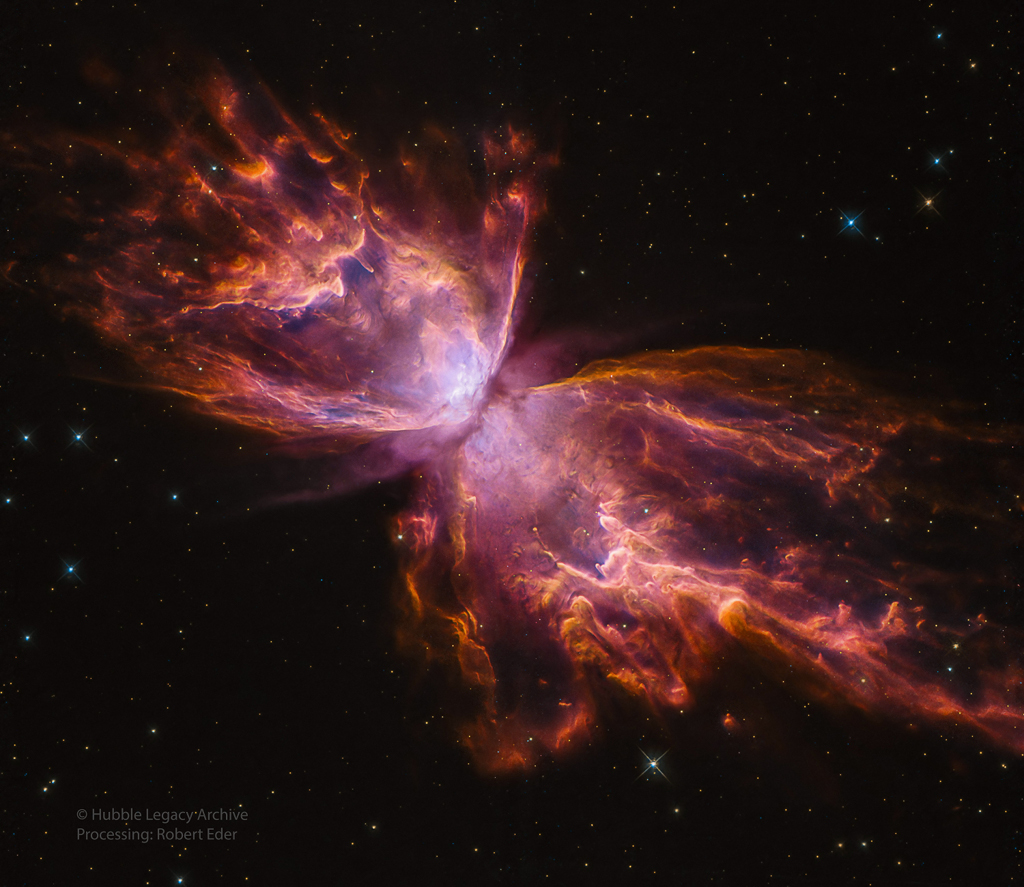

NGC 6302: The Butterfly Nebula
The bright clusters and nebulae of planet Earth's night sky are often named for flowers or insects. Though its wingspan covers over 3 light-years, NGC 6302 is no exception. With an estimated surface temperature of about 250,000 degrees C, the dying central star of this particular planetary nebula has become exceptionally hot, shining brightly in ultraviolet light but hidden from direct view by a dense torus of dust. This sharp close-up was recorded by the Hubble Space Telescope in 2009. The Hubble image data is reprocessed here, showing off the remarkable details of the complex planetary nebula. Cutting across a bright cavity of ionized gas, the dust torus surrounding the central star is near the center of this view, almost edge-on to the line-of-sight. Molecular hydrogen has been detected in the hot star's dusty cosmic shroud. NGC 6302 lies about 4,000 light-years away in the arachnologically correct constellation of the Scorpion (Scorpius).

March 02, 2019
via NASA https://ift.tt/2NK2cdH
Space

Manage this Applet


Unsubscribe from these notifications or sign in to manage your Email Applets.

IFTTT

PM Showers tomorrow!


Tomorrow, March 02, 2019, there will be a low of 41F (5C) and a high of 51F (11C)
To geek-out on your hyperlocal forecast, visit Weather Underground.
If this weather report is not for the correct location, you can change your location here.
Weather Underground

Manage this Applet


Unsubscribe from these notifications or sign in to manage your Email Applets.

IFTTT

2019年2月28日星期四

NASA News: NASA Secures First International Partnership for Moon to Mars Lunar Gateway

NASA Secures First International Partnership for Moon to Mars Lunar Gateway
The following is a statement from NASA Administrator Jim Bridenstine on the announcement Thursday by Canadian Prime Minister Justin Trudeau about Canada's support for the Gateway lunar outpost and deep space exploration:

Published February 28, 2019
Read more from NASA
Space

Manage this Applet


Unsubscribe from these notifications or sign in to manage your Email Applets.

IFTTT

NASA News: NASA Awards Contract for Protective Services at Houston Facilities

NASA Awards Contract for Protective Services at Houston Facilities
NASA has awarded a contract to Praetorian Standard Inc., of Fayetteville, North Carolina, a service disabled veteran-owned small business, to provide comprehensive security services at the agency's Johnson Space Center in Houston, as well as facilities managed by Johnson.

Published February 28, 2019
Read more from NASA
Space

Manage this Applet


Unsubscribe from these notifications or sign in to manage your Email Applets.

IFTTT

NASA Image of the Day: SpaceX Demo-1: 'Go' for Launch


SpaceX Demo-1: 'Go' for Launch
Two days remain until the planned liftoff of a SpaceX Crew Dragon spacecraft on the company's Falcon 9 rocket—the first launch of a commercially built and operated American spacecraft and space system designed for humans.

February 28, 2019
via NASA https://ift.tt/2Ud9okS
Space

Manage this Applet


Unsubscribe from these notifications or sign in to manage your Email Applets.

IFTTT

唤醒书写情怀的德国凌美钢笔限时79元/支包邮,点击抢购>>

1111

2019年2月27日星期三

Astronomy Picture of the Day: Sharpest Ultima Thule


Sharpest Ultima Thule
On January 1, New Horizons swooped to within 3,500 kilometers of the Kuiper Belt world known as Ultima Thule. That's about 3 times closer than its July 2015 closest approach to Pluto. The spacecraft's unprecedented feat of navigational precision, supported by data from ground and space-based observing campaigns, was accomplished 6.6 billion kilometers (over 6 light-hours) from planet Earth. Six and a half minutes b efore closest approach to Ultima Thule it captured the nine frames used in this composite image. The most detailed picture possible of the farthest object ever explored, the image has a resolution of about 33 meters per pixel, revealing intriguing bright surface features and dark shadows near the terminator. A primitive Solar System object, Ultima Thule's two lobes combine to span just 30 kilometers. The larger lobe, referred to as Ultima, is recently understood to be flattened like a fluffy pancake, while the smaller, Thule, has a shape that resembles a dented walnut.

February 28, 2019
via NASA https://ift.tt/2UjlMQ4
Space

Manage this Applet


Unsubscribe from these notifications or sign in to manage your Email Applets.

IFTTT